Showing posts with label Jaguar. Show all posts

Tuesday, April 19, 2011

2011 Jaguar X Type Sport Premium Specifications, Pictures, Prices

2011 Jaguar X Type Sport Premium Specifications, Pictures, Prices
Jaguar Car newshttp://designscarswallpaper.blogspot.com/search/label/Jaguar%20cars
Jaguar X Type Sport Premium. Used 2009 (09) Jaguar X-typeJaguar X Type Sport Premium. Jaguar X Type 2.2D (EU4) SportJaguar X Type Sport Premium. Jaguar X-Type Sport PremiumJaguar X Type Sport Premium. Jaguar X-type Sport Premium,Jaguar X Type Sport Premium. Used Jaguar X-TYPE V6 SportJaguar X Type Sport Premium. MakeJaguar X-Type; ModelSPORTJaguar X Type Sport Premium. Jaguar X-type 2.0D (EU4) Sport

Wednesday, April 13, 2011

Monday, April 11, 2011

2011 jaguar xj6 vanden plas car review and wallpapers, specification

2011 jaguar xj6 vanden plas car review and wallpapers, specification

1995 Jaguar XJ6 Vanden Plas. ◄ Prices · Technical Specifications ► Jaguar XJ6 Vanden Plas beige metallic - 1995 - Thumbnail Picture 1985 Jaguar XJ6 Vanden Plas (Series III)1995 Jaguar XJ6 Vanden Plas Sedan1991 Jaguar XJ-Series 4 Dr XJ6 Vanden Plas Sedan picture, exterior1995 Jaguar XJ6 Vanden Plas Kansas City, MO1996 Jaguar XJ6 Vanden Plas

Friday, April 8, 2011

Monday, March 21, 2011

Jaguar XF 10 history Cars Wallpapers and Reviews specification

Jaguar XF 10 history Cars Wallpapers and Reviews specification
Jaguar XF 10 Jaguar XF 10 Jaguar XF 10 Jaguar XF 10 Jaguar XF 10 Jaguar XF 10

Jaguar XK Cabrio Engine Cars Wallpapers and Reviews specification

Jaguar XK Cabrio Engine Cars Wallpapers and Reviews specification
displacement:4196 ccm
Fuel:Petrol - unleaded
Engine type:V 8-Cylinde
Engine power:219 kW / 298 KM
Engine torque:411 Nm
Transmission:Automatic, sequential
Actuation:Rear drive
Jaguar XK CabrioJaguar XK CabrioJaguar XK CabrioJaguar XK CabrioJaguar XK CabrioJaguar XK CabrioJaguar XK CabrioJaguar XK CabrioJaguar XK Cabrio

Monday, February 7, 2011

Jaguar XJ13, 1966

Jaguar XJ13, 1966


The Jaguar XJ13 was a prototype racing car developed by Jaguar to challenge at Le Mans in the mid-1960s. It never raced, and only one was ever produced.

Jaguar had considered the manufacture of a V12 engine as far back as 1955, initially for racing purposes, and then developing a road going version, unlike the XK which was designed as a production engine and later pressed into service for racing. The engine design was essentially two XK 6-cylinder engines on a common crankshaft with an aluminium cylinder block, although there were differences in the inlet porting, valve angles and combustion chamber shape. The first engine ran in July of 1964.

The idea of a mid-engined prototype was first mooted in 1960, but it was not until 1965 that construction began, with the first car running by March 1966. The aluminium body was designed by Malcolm Sayer, the aerodynamicist responsible for the Jaguar C-Type, D-Type, E-Type and XJ-S, who used his Bristol Aeroplane Company background to build it using techniques borrowed from the aircraft industry.

The Jaguar XJ13 had mid-engine format with the 5.0 litre V12 engine mounted behind the driver, used as a stressed chassis member together with the five-speed manual ZF Transaxle driving the rear wheels.

The front suspension wishbones were similar to that of the E-Type, however where the E-Type used longitudinal torsion bars, the Jaguar XJ13 had more conventional coil spring/damper units. At the rear there again remained similarities with the E-Type - the use of driveshafts as upper transverse links - however the rest was quite different, with two long radius arms per side angling back from the central body tub together with lower links.

The development of the Jaguar XJ13, although treated seriously by the designers, was never a priority for company management (despite assistant MD Lofty England's Le Mans success in the 1950s), and became less so following the 1966 merger with BMC. By that time Ford had developed the 7.0 litre GT40, and so the Jaguar XJ13 was considered obsolete by the time the prototype was complete. The prototype was tested at MIRA and at Silverstone, which confirmed that it would have required considerable development to make it competitive. The prototype was put into storage and no further examples were made.

Jaguar Mark 2, 1959

Jaguar Mark 2, 1959


The Jaguar Mark 2 is a medium sized saloon car built from 1959 to 1967 by the Jaguar company in Coventry, England, as successors to the Jaguar 2.4 and 3.4 models, manufactured between 1957 and 1959. These retrospectively became known as the Jaguar Mark 1 following the release of the Mark 2 in 1959.

Adhering to Sir William Lyons' maxim of "grace, pace and space", the Mark 2 was a beautiful, fast and capable saloon. It came with a 120 bhp 2.4 L, 210 bhp 3.4 L or 220 bhp 3.8 L Jaguar XK6 engine. The 3.8 is similar to the unit used in the 3.8 E-Type (XKE), having the same block, crank, connecting rods and pistons but different inlet manifold and carburetion (two SUs versus three on the E-Type in Europe) and therefore 30 bhp less. The head of the six cylinder engine in the Mark 2 had curved ports compared to the straight ports of the E-Type configuration. For markets other than the US the 3.4 was fitted with twin SU carburettors and the 2.4 with twin Solexes, but three Solexes were used in US spec 3.4s and 3.8s in order to meet SMOG emissions legislation. This reduced power output over the equivalent SU carburetted examples.

The Daimler 2.5 litre engine was fitted to the Daimler 250 derivative of the Mark 2 (In European markets known as the Daimler 2.5-V8 then Daimler V8-250), having first been used in the Daimler SP250 sports car (the SP250 was originally known as the Daimler Dart but "Dart" was a trademark of Dodge and had to be dropped by Daimler under threat of legal action.) The aluminium alloy Daimler engine was lighter than the cast iron block Jaguar sixes, therefore reducing the mass over the front wheels and hence reducing understeer compared to the XK-powered versions under hard cornering. These models were recognisable by the characteristic Daimler wavy fluting incorporated in the chrome grille instead of the Jaguar badge and figurine.

The Mark 2 was discontinued in September 1967 and replaced by the 240 and 340, so named to distinguish them from the old 2.4 and 3.4 which, as noted above, became known as the Mark 1 following the introduction of the Mark 2 in 1959. The Jaguar 240 and 340 were interim models to fill the gap until the introduction of the XJ6 in September 1968. The 340 was discontinued immediately but the 240 continued as a budget priced model until April 1969; its price of £1364 was only £20 more than the first 2.4 in 1956. (Eric Dymock, The Jaguar File, 3rd edition, 2004, Dove Publishing.)

The economies of the new 240 and 340 models came at a cost - the leather upholstery was replaced by 'Ambla' leather-like material and slimmer, more economical front and rear bumpers were introduced. Other changes included the replacement of the front fog lamps with circular vents and optional fog lamps for the UK market. The sales price was reduced to compete with the Rover 2000 TC.

The 240's performance was improved over the old 2.4 model by upgrading the 2.4's cylinder head and twin Solex carburettors to the straight port 'E-Type' head and twin SU carburettors. For the first time the 2.4 litre model could exceed 100 mph resulting in a slight sales resurgence.

Performance
A 3.4 litre car with automatic transmission tested by The Motor magazine in 1961 had a top speed of 119.9 mph (193.0 km/h) and could accelerate from 0-60 mph (97 km/h) in 11.9 seconds. A touring fuel consumption of 19.0 miles per imperial gallon (14.9 L/100 km; 15.8 mpg-US) was recorded. The test car cost £1951 including taxes of £614.

A 3.8 litre car with the 220 bhp engine was capable of accelerating from 0-60 mph (97 km/h) in 8.5 seconds and could reach a top speed of 125 mph (201 km/h).

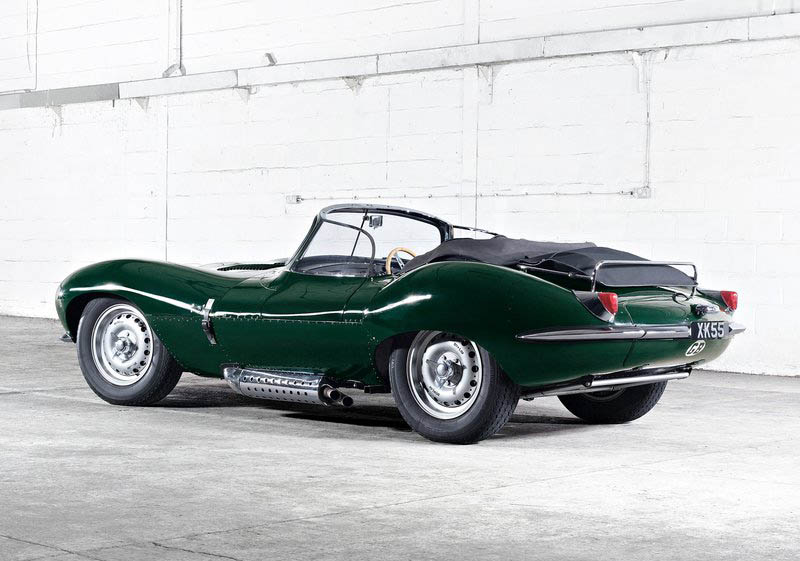
Jaguar XK SS, 1957

Jaguar XK SS, 1957


Jaguar withdrew from racing the company offered the remaining, unfinished chassis as the roadgoing Jaguar XK SS, by making changes to the racers: adding an extra seat, another door, a full-width windshield and folding top, as concessions to practicality. However, on the evening of 12 February 1957, a fire broke out at the Browns Lane plant destroying nine of the twenty-five cars that had already been completed or were semi-completed. Production is thought to have included 53 customer D-types, 18 factory team cars, and 16 XK SS versions.

Following Jaguar's withdrawal from competition at the end of the 1955 season, a number of completed and partially complete D-types remained unsold at the Browns Lane factory. In an attempt to recoup some of the investment made in building these unused chassis, and to exploit the lucrative American market for high-performance European sports cars, Sir William Lyons decided to convert a number to full road-going specification. Only minor changes were made to the basic D-type structure: the addition of a passenger side door, the removal of the large fin behind the driver's seat, and the removal of the divider between passenger and driver seats. In addition, changes were made for cosmetic, comfort and legal reasons: a full-width, chrome-surrounded windscreen was added; sidescreens were added to both driver and passenger doors; a rudimentary, folding, fabric roof was added for weather protection; chromed bumpers were added front and rear (a styling cue later used on the E-type); XK140 rear light clusters mounted higher on the wings; and thin chrome strips added to the edge of the front light fairings. In total 16 Jaguar XK SS were made, with most being sold in the USA, before the Browns Lane fire destroyed the remaining chassis.

Jaguar XK140, 1955

Jaguar XK140, 1955


The Jaguar XK140 is a sports car manufactured by Jaguar between 1954 and 1957, the successor to Jaguar's highly successful XK120. Upgrades included better brakes, rack and pinion steering, increased suspension travel and modern tube type shock absorbers instead of the older lever arm design.

The Jaguar XK140 was introduced in late 1954 and sold as a 1955 model. The primary visual change was the more substantial front and rear bumpers, with large overriders. Another new feature was modern flashing turn signals, operated by a separate switch on the dash. The twin amber lights positioned above the front bumper helped to distinguish the XK140 - until XK120 owners started installing the same equipment.

Front grille size stayed the same but became a one piece cast unit with fewer, thicker vertical slats. The Jaguar badge was fitted to the grille itself, rather than being mounted between the grille and hood/bonnet as on the XK120. A chrome trim strip extended back over the bonnet and at the rear continued down the centre of the boot (trunk) lid, where it contained a red shield with the words 'Winner Le Mans 1951-3' inscribed in gold.

The interior was improved for taller drivers with an addition of 3 inches (76 mm) of legroom, as a result of relocating the engine, firewall and dash forward. The new arrangement left no room for the XK120 battery compartment, and the single battery was now located low down inside the wing on the inlet side, making it almost impossible to replace.

The Jaguar XK140 continued to feature the famous Jaguar XK engine with the Special Equipment modifications from the XK120 as standard, increasing the specified power by 10 bhp to 190 bhp (142 kW) gross at 5500 rpm. The special C-Type cylinder head was also carried through from the XK120 catalogue as an option, specified at 210 bhp (157 kW) gross at 5750 rpm.

A car fitted with the C-type cylinder head, 2-inch sandcast H8 carburettors, heavier front torsion bars and twin exhaust pipes was known in the UK as an XK140 SE. In North America it was popularly called an XK-140 MC.

In 1956, the XK140 was the first Jaguar sports car to be offered with an automatic transmission. As with the XK120, the availability of wire wheels and dual exhausts were options although most cars imported into the United States had wire wheels. Cars with disc wheels continued to be offered with fender skirts (spats) closing the rear wheel arch.

The Jaguar XK140 was available in three body styles. The OTS (Open Two Seater) roadster had a light canvas top assembly that when lowered fitted behind the seats and thus completely disappeared inside the body. The interior of the OTS was trimmed in leather and leatherette, including the dash. Like the XK120 Roadster, the Jaguar XK140 OTS had removable canvas and plastic side curtains on light alloy doors, and either a long or short tonneau cover to keep the cockpit dry with the top down.

As well as real wind-up windows, the DHC (Drop Head Coupe) had a permanently-mounted padded soft top that when lowered sat above and outside the body of the car. it also had a fixed windscreen (unlike the removable windscreen of the OTS). The DHC had a very elegant walnut-veneered dash and door cappings, as did the FHC (Fixed Head Coupe). As a gesture to practicality, a jump seat was added to both coupe models. The FHC's windscreen was mounted further forward, giving it considerably more interior space than the DHC.

 
Designs Cars Wallpaper powered by blogger.com
Design by : Fashion