In 2010 the Volvo PV36 celebrates its 75th anniversary - and let us right from the beginning state: It is not a copy of the Chrysler Airflow which it has been accused of.
The history of these cars is yet another version of the eternal question about whichever was first, the chicken or the egg. What is the truth? Yes, Chrysler was first to put its Airflow on the market in 1934, but that does not automatically mean that Volvo copied its styling. That could not have worked from a timing point of view since the Volvo made its debut less than a year later. Such short leadtimes do not exist even today, and definitely not 75 years ago.
At the beginning of the 1930s, annual sales of Volvos amounted to less than 1,000 cars. They were conventional and rather similar models; six cylinder engines in sturdy frames, steel panels on wooden body framework, separate wings and running boards, outside luggage trunks, upright radiators and separate headlamps. They looked like most cars did at the time, however unusually well designed and built. Responsible for the restrained styling of the first Volvo cars was artist Helmer MasOlle.
 One man's work
The Volvo PV36 which arrived in the spring of 1935 bore, however, no traces of the painter's hand. This car was one man's work and that man was Ivan Örnberg, a headstrong and versatile engineer who came to Volvo in 1931 from the Hupp Motor Co in Detroit, makers of Hupmobile. Without the interference of either Assar Gabrielsson or Gustaf Larson, the usually very engaged and interested founders of Volvo, Örnberg ran the PV36 project from start to finish. Almost. He died suddenly in the late summer of 1936 when the car was just little more than a year.
From where did Ivan Örnberg get his inspiration for the Volvo PV36, and how? At around 1930, aerodynamics and streamlined vehicles had become the objects of many a thinker and progressive engineer. This was the age of the large airships and their shape is maybe the most concrete example of these theories, plus a number of early locomotives, airplanes and car prototypes.There were several different prototypes around, but no car manufacturer dared to put anything in production until Hupmobile and Chrysler Corporation did it, almost simultaneously.

In 1933, however, Volvo did show a streamline car, but afraid of the reactions of the public used a private person as responsible front figure - Gustaf L-M Ericsson of telephone company fame. Ericsson was named designer of the car and the project was his brainchild. "Venus Bilo" used a Volvo 655 chassis and had a full-width body with a front not unlike that of the Hupmobile Aerodynamic a year later. Its smooth shape was rounded at the rear with the spare wheel slotted in horizontally and acting as rear bumper. The idea of the car was to cut fuel consumption and prevent the creation of swirling road dust by using a streamlined body with a fully covered underside. Interesting and daring it was a prototype and as such it stayed, disappearing in the 1950s.
To conceive, design, style and manufacture a car takes a lot of time and effort today, and did so also in the 1930s. To proceed from idea via drawings and scale models to a real car with all that is needed in terms of tools, components and production development, is a process that takes several years.
Ivan Örnberg moved back to Sweden in 1931. At that time neither Hupmobile - where he worked as an engineer - nor Chrysler had come very far with their streamline plans. Hupmobile not at all in fact, because they only got started in 1932 when Raymond Loewy - maybe the most famous of all industrial designers and automobile stylists in automotive history - was hired by the company in order to boost sales of the slow-selling cars.
At the same time Chrysler's streamline man Carl Breer was still occupied with different scale models in the wind tunnel and Örnberg had already been working a year for Volvo. It is therefore not only difficult but merely impossible, to image a contact, let alone conversations, across the Atlantic between Breer, Loewy and Örnberg on the subject of streamline cars. And pictures could not be transferred quicker than by mail or personal messenger.
The first stream linersAt the beginning of 1934, the Hupmobile Aerodynamic was presented. From the windscreen and forward it had a certain plough like streamline shape, but the rest of it was rather conventional. It was good-looking though without any particular individuality. It had a fully-pressed steel body, including the entire roof, fitted to a separate frame and was from a technical standpoint not in any way extreme.
Extreme, however, describes the definitely more daringly styled Chrysler Airflow - and its cheaper sister car De Soto Airflow - that arrived during the spring of 1934. They had a one-piece rounded front or face, a grille that looked like a waterfall and low-positioned faired-in headlamps.
Restrained streamliningThe Volvo PV36 was equipped with the latest six cylinder engine version, the EC of 3.67 litres capacity and with just over 80 horsepower. It sat below a bonnet which was integrated with the front where the headlamps were faired in, surrounding a traditional but nicely stylized Volvo radiator grille which followed the shape of the front rather than standing on its own like on other Volvos. The front wings were still almost separate and if the headlamps had been placed on top of them, rather than being blended into the front, the streamline ambitions would hardly have been noticed.
It is in fact the position and look of the headlamps that really make this car what it is, and remind the observer of the Chrysler Airflow. But calling the Carioca a copy cat would be wrong. The differences are too big and too many between these cars. And regarding the Hupmobile, there is virtually no resemblance at all.
Volvo PV36 had both front and rear doors hinged to the B-pillar, like the Hupmobile, whereas the doors of the Chrysler and the De Soto were hinged the opposite way around: front door to A-pillar and rear door to C-pillar with the B-pillar used for locking both doors. Like the Airflow, the PV36 also had rear wheel spats with a small chromium decor. These decors, admittedly, are virtually identical at a quick glance. Maybe Örnberg saw it on the Airflow in 1934, was inspired and hurried to order something similar, or bought it from the shelf from the same supplier as Chrysler.
The rear end of the Volvo body was sloping with a split rear-window, and a built-in luggage compartment (the first on a Volvo) with the spare-wheel on the outside of the lid in its own steel casing. This was also roughly how the other streamline cars looked, but their luggage compartments could not be opened from the outside like the Volvo's.
The car of tomorrow - and yesterdayThe designation PV36 had nothing in common with the logical numbering used on the other Volvo models. Instead it was thought to evoke a feeling that "the car of the future has arrived already today", in other words the 36 already in 1935. If those responsible for this had given it another thought, they would have discovered how quickly this thought about the future could be reversed into the opposite. The last PV36s were only sold in September 1938.
Why Carioca?But why is the car called the Carioca, like the dance? It is actually not called Carioca but PV36. Carioca is only a nickname but it has persistently clung to the car during all these years and is maybe more known and used than the actual correct designation.
The swinging Carioca was danced for the first time in the Hollywood motion picture "Flying down to Rio" from 1933 by Fred Astaire and Ginger Rogers, in their first movie appearance together. It is a very passionate dance from Central America where the foreheads of the dancing couple must touch now and then during the dance.
Carioca is also the official nickname for a native Rio citizen. Because of the fact that Volvo's export to Brazil started very early, already in 1933, one can suppose that the name Carioca was used as a flirt with the Brazilian market in the sense that it would associate to the people of Rio rather than the dance. Some Cariocas did finally end up in Brazil.
Costly experiencesJust like the Hupp Motor Co and Chrysler Corporation, AB Volvo in Sweden also had to accept the sad fact that cars like these did not really have a market in the mid-1930s.They were twenty years ahead of their time with their streamlined and unconventional bodies. Car customers - and Volvo customers in particular - wanted conventional styling in harmony with the times, small visual changes.
It the autumn of 1938 the last Volvo PV36 Carioca was sold. By then, the Volvo PV51 and PV52 had already been on the market for two years, founding the basis for all other Volvos to enter the market during the rest of the 1930s. Viewed from behind, these cars showed resemblance to the Volvo PV36 but they featured the traditional Volvo front; separate headlights and an upright radiator grille leaned slightly backwards. Meanwhile, the Olofström press plant had developed new tools and solved the problems with large one-piece pressings; these cars had all-steel bodies.
 Some streamline key years
 * 1931 - Örnberg leaves Hupmobile and moves to Sweden and Volvo
* 1932 - Raymond Loewy begins at Hupmobile
* 1933 - Airflow available as wooden scale model
* 1934 - Hupmobile Aerodynamic, Chrysler Airflow and De Soto Airflow are presented at the beginning of the year.The Airflows are of unitary construction. All have beam front axle and live rear axle.
* 1935 - Volvo PV36 is launched in March, featuring independent front suspension
* 1936 - Hupmobile Aerodynamic is discontinued due to slow sales.
* 1937 - Airflow is discontinued after four years of constantly sluggish sales.
* 1937 - Adler Autobahn is launched
* 1938 - The last Volvo PV36 is sold, three years after its market intro. In total 500 cars and one bare chassis.
* 1940 - Adler Autobahn is discontinued.
A common fact for all these cars is that they were built in relatively small numbers since sales never really took off. They were expensive adventures for the companies with regards to tooling and production equipment and at the same time very interesting from a technical and historical point of view.
Volvo is neither a copy of the Airflow, nor the Hupmobile Aerodynamic. When Örnberg left for Sweden in 1931, there were no models or tools to look at. What could he have seen and where? On the other hand, it is a well-known fact that great minds think alike, and quite often at the same time. For instance, messrs Daimler and Benz built their respective cars only 100 km away from each other, knowing nothing of each others existence and they never actually met.


 In March 1985, Volvo Car Corporation showed the result of yet another cooperation in the field of luxury between Sweden and Italy, the Volvo 780, designed and built by Bertone in Turin. The event took place on the Volvo Cars stand at the 1985 Geneva Motor Show.
 There were three engines to choose from: the 2.8 litre V6, a turbocharged four or the straight-six turbo diesel that Volvo used at the time. None of these engines, however, were capable of giving the car a top speed of 200 kph (125 mph) which is a psychological threshold on the German Autobahn, but it was exclusive, comfortable and quiet. It was primarily aimed at the USA, Japan and a few markets in Europe, one of them was Sweden.
 Visually different from most of its contemporaries, and totally different from every other Volvo car. The Volvo PV36, perhaps better known as the Carioca, is an exciting chapter in the Volvo history. It is also quite famous in automotive history if you consider how few examples were actually built and by such a small manufacturer like Volvo Car Corporation.
 One man's work
 In 1933, however, Volvo did show a streamline car, but afraid of the reactions of the public used a private person as responsible front figure - Gustaf L-M Ericsson of telephone company fame. Ericsson was named designer of the car and the project was his brainchild. "Venus Bilo" used a Volvo 655 chassis and had a full-width body with a front not unlike that of the Hupmobile Aerodynamic a year later. Its smooth shape was rounded at the rear with the spare wheel slotted in horizontally and acting as rear bumper. The idea of the car was to cut fuel consumption and prevent the creation of swirling road dust by using a streamlined body with a fully covered underside. Interesting and daring it was a prototype and as such it stayed, disappearing in the 1950s.
 Some streamline key years
 2010 Volvo C30 BEV Front View
 2010 Volvo C30 BEV Wallpaper
 2010 Volvo C30 BEV Side View
 2010 Volvo C30 BEV Interior
 2010 Volvo C30 BEV Action
 2010 Volvo C30 BEV Dashboard
 2010 Volvo C30 BEV Rear View


 2010 Volvo C30 interior
 2010 Volvo C30 side view
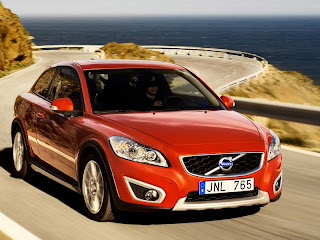 2010 Volvo C30 test drive


